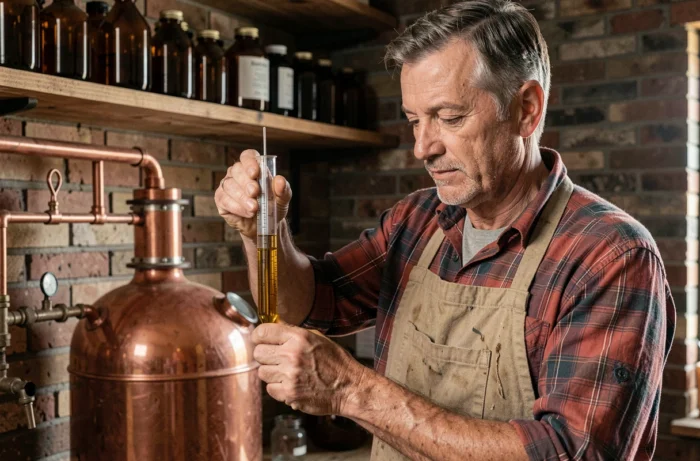
Homemade whisky starts with a fermented grain mash, technically similar to an un-hopped beer. The subsequent processes (distillation, maturation) fall under a strict regulatory framework that must be mastered even before heating a still. This guide lays the technical foundations for producing a grain alcohol and understanding what separates a raw distillate from whisky in the legal sense.
Regulatory Framework: Home Distillation and Whisky Designation in France
Home distillation of alcohol intended for consumption is not permitted in France. The regimes for distillers primarily concern fruit brandies, not grains. Before any attempt, we recommend checking the situation with the DGDDI (General Directorate of Customs and Indirect Taxes) or the competent customs service.
Regulation (EU) 2019/787, applicable since May 25, 2021, precisely defines what can be called whisky in the European Union. Maturation must last at least three years in wooden containers with a maximum capacity of 700 liters. The finished product must reach at least 40% ABV.
This same regulation prohibits the addition of alcohol, sweetening, and flavoring after distillation. Only water and ordinary caramel E150a (for coloring) are allowed. Commercial kits offering accelerated maturation with chips or flavors produce a “whisky-inspired” drink, but not whisky in the regulatory sense. You will find more tips on capitainecomment.fr to delve into the practical aspects of production.
Choice of Grains and Impact on the Aromatic Profile of Whisky
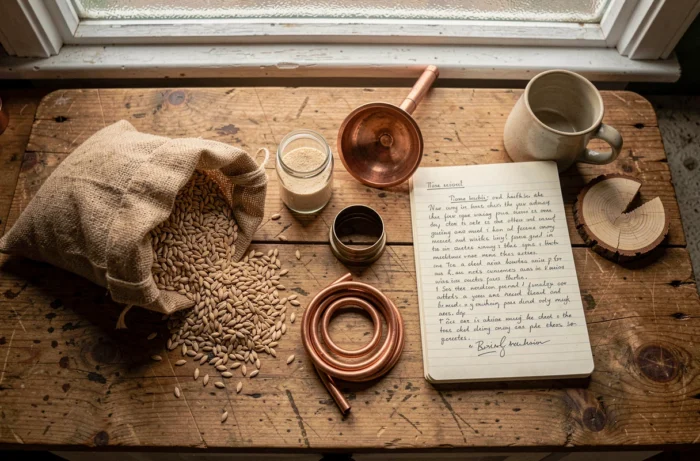
Malted barley remains the most common base outside of bourbon tradition. It offers better enzymatic yield during mashing and a more efficient starch-to-sugar conversion than most other grains. Barley malt also imparts characteristic notes of biscuit and toasted grain depending on the level of roasting.
Corn, widely used across the Atlantic, produces a rounder and slightly sweeter distillate. To obtain the bourbon designation in the United States, the recipe must contain more than half corn. Rye, on the other hand, brings a spicy and peppery signature, highly sought after in rye whiskeys.
Three less common grains deserve attention:
- Wheat produces a sweeter and floral distillate, often used in combination with barley to soften the overall profile of the mash.
- Buckwheat generates earthy and rustic notes, utilized by a few craft distilleries in France to create atypical whiskies.
- Spelt, an ancient cousin of wheat, adds extra complexity with nutty aromas, but its yield is lower.
The choice of grain determines the character of the distillate much more than the type of barrel used afterward. We observe that many beginners underestimate this step in favor of maturation.
Mashing and Fermentation: Transforming Starch into Alcohol
Mashing is the step that distinguishes a good mash from a mediocre one. The crushed malt is mixed with hot water to activate the enzymes (alpha and beta-amylase) that convert starch into fermentable sugars. The temperature of the water during this infusion is critical: too low, the conversion is incomplete; too high, the enzymes denature.
The mash obtained after filtration (separation of the spent grains) resembles a sweet cereal juice. This is where yeast comes in. Distilling yeast yields better results than standard baking yeast, as it tolerates higher alcohol levels and produces fewer undesirable compounds.
Fermentation generally lasts several days. The container (carboy, fermentation bucket) must be equipped with an airlock to allow CO2 to escape without letting air in. A poorly fermented mash produces a distillate loaded with fusel oils, responsible for harsh flavors and headaches.
Maturation in Oak Barrel: What Transforms a Distillate into Whisky
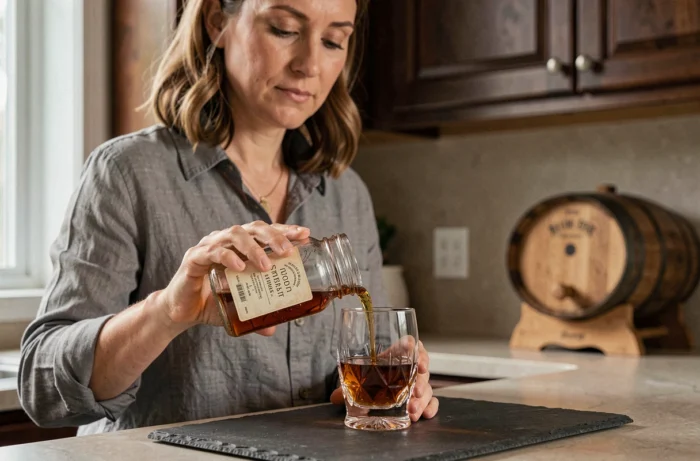
Without maturation, a grain distillate remains a harsh, monolithic white spirit. The oak barrel imparts color, some of the aromas (vanilla, caramel, spices), and especially a refinement through micro-oxygenation via the wood.
The size of the barrel directly influences the speed of maturation. A small barrel of a few liters exposes proportionally more alcohol to the wood than a standard barrel, which accelerates the exchanges. However, a barrel that is too small can saturate the distillate with tannins and produce a woody and astringent result in just a few months.
For enthusiasts wishing to experiment legally (on a non-distilled fermented mash or on a commercial spirit), here are the parameters to monitor:
- The origin of the oak: American oak releases more vanillin and lactones, while European oak provides more tannins and spices.
- The toasting of the barrel: a light toast preserves fine woody notes, while a heavy toast develops caramel and smokiness.
- The history of the barrel: a barrel that previously contained sherry, port, or bourbon imparts residual aromas to the distillate, what the industry calls “finishing.”
- The storage temperature: marked seasonal variations accelerate exchanges between the wood and the liquid.
The European rule of a minimum of three years in a maximum 700-liter barrel is not a bureaucratic whim. It ensures that the final product has truly been transformed by the wood, not just artificially colored or flavored.
Making whisky in the strict sense therefore requires patience, regulatory rigor, and a quality mash. Mashing and fermentation condition the potential of the distillate, but it is maturation that determines the final result. It is better to invest in good malt and an appropriate barrel than in expensive distillation equipment used outside the legal framework.