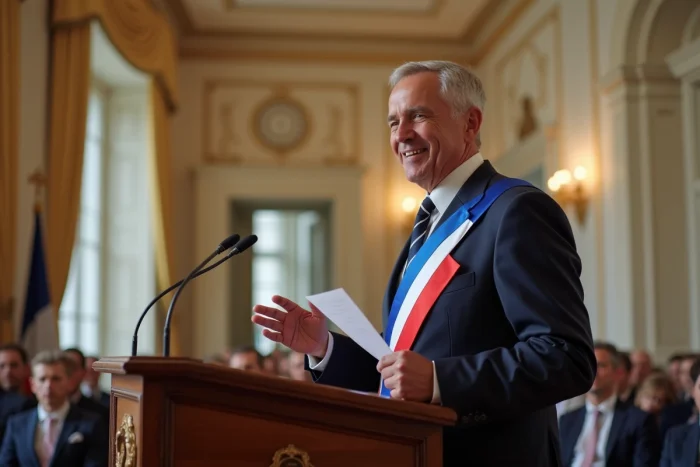
The legal framework of civil marriage gives the mayor total freedom regarding the form of the speech. No decree or circular imposes a structure, duration, or stylistic register. The only obligation is the reading of the articles of the Civil Code relating to the rights and duties of spouses. Everything else falls under the personal composition of the civil status officer, and it is precisely this freedom that makes the exercise daunting.
Republican Framework of the Mayor’s Speech and Editorial Margin
We regularly observe a confusion between the protocol of the civil ceremony and the content of the speech. The protocol is set: identity verification, reading of the articles, exchange of consents, signing of the registers. The speech, on the other hand, is built around these mandatory steps without replacing them.
The citizen dimension takes precedence. A mayor’s speech for a civil marriage does not serve the same function as a speech at a secular ceremony. The INED has noted that many mayors refocus their remarks on the legal and republican dimension of the union to avoid redundancy with secular ceremonies, which are increasingly common alongside the civil ceremony.
The mayor speaks on behalf of the Republic, not in their own name. This distinction conditions the language register, the choice of references, and the posture towards the assembly. Any anecdote or personal touch remains framed by this institutional function.
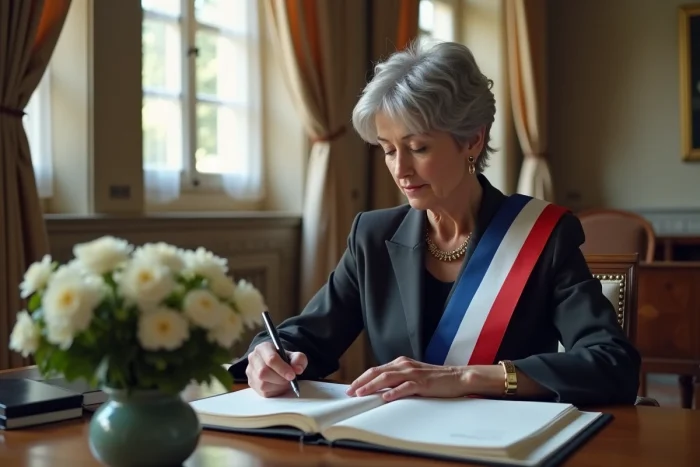
Writing the Civil Marriage Speech: Structure and Sequencing
An effective mayor’s speech lasts between five and eight minutes. Beyond that, the guests’ attention wanes, especially in a civil status hall without sound amplification. We recommend a sequencing into three distinct blocks, each with a specific function.
Opening Block: Institutional Anchoring
The first two or three sentences set the framework. Mention of the municipality, the location, the date. No literary quote as a hook; this is a reflex of secular ceremonies that dilutes the republican authority of the moment.
Addressing the spouses by their first names from the very first sentence creates immediate closeness without compromising solemnity. The transition to the collective “you” (family, witnesses, guests) comes just after.
Central Block: Controlled Personalization
This is the only segment where the mayor can incorporate elements specific to the couple. The Association of Mayors of France notes an increase in written requests from couples to adapt the speech to their story and commitments. Welcoming these requests requires a method.
- A preliminary interview with the future spouses allows for the collection of two or three factual elements: circumstances of the meeting, common project, shared value. No more, lest the speech turn into a biography.
- Each personal element must be linked to a universal value (commitment, solidarity, transmission) to resonate with the entire assembly, not just the front row.
- Same-sex couples, blended families, intercultural unions call for inclusive vocabulary. Several municipalities have distributed internal guides since the 2013 law to adapt formulations to diverse family configurations.
Limiting personalization to three concrete elements avoids the pitfall of a portrait speech that drags on. The mayor is not the master of a secular ceremony; their role is to give depth to the legal framework, not to tell a love story.
Closing Block: Transition to the Articles of the Civil Code
The reading of the articles (212, 213, 214, and 215 of the Civil Code) constitutes the legal pivot of the ceremony. The speech must lead there naturally. A linking sentence is sufficient: it announces the transition from the personal register to the legal register without breaking tone.
End the personal block with a short, affirmative sentence looking towards the couple’s future, then proceed to the reading. No grandiloquent transition between the speech and the articles.
Frequent Register Errors in Mayoral Speeches at Town Halls
Humor is the most documented trap. A witty remark that works in a witness’s speech falls flat in the mouth of a civil status officer. The institutional framework alters the reception of every word.
Another pitfall: emotional overload that obscures the legal framework. When the mayor’s speech resembles that of a close friend, guests lose sight of the legal significance of the act. Consent, signing of the registers, mutual obligations become mere administrative formalities instead of constituting the heart of the ceremony.
Literary or poetic quotes pose a neutrality problem. Saint-Exupéry, Aragon, or Khalil Gibran appear in the majority of speeches published online. Beyond the effect of repetition, a quote ideologically steers the remarks without the mayor always being aware of it. Prefer a personal formulation, even if less elegant, that remains grounded in the couple’s reality.
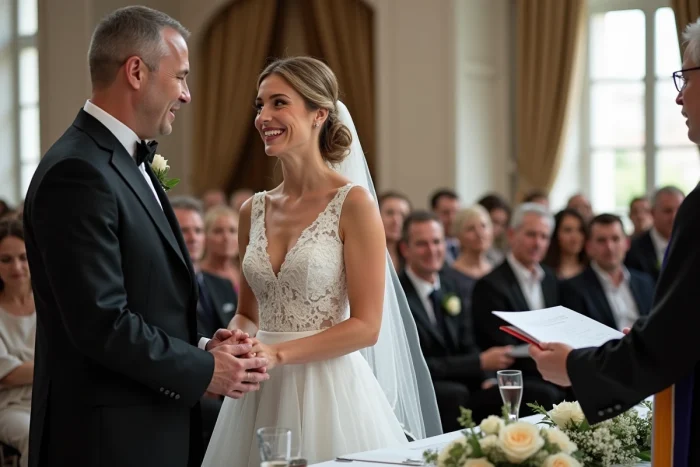
Adapting the Mayor’s Speech to New Marital Configurations
The increase in written requests noted by the AMF reflects a change in couples’ posture. Ecological values, feminist commitment, rejection of traditional gendered formulations: these requests are no longer marginal and require vigilance from the elected official.
From a writing perspective, replacing “husband and wife” with “spouses” or “partners” is not enough. The entire structure of the speech must be conceived in neutral vocabulary by default, then adjusted if the couple expresses a preference. Starting from an inclusive base is simpler than correcting a text written on a heteronormative model.
- Systematically check for the absence of assumptions about the distribution of roles in the couple.
- Adapt references to parenthood if the couple already has children, children from previous unions, or does not wish to have any.
- Avoid formulations that presuppose a complementary religious ceremony (“before God and before men” remains understood in some town halls).
The republican speech is distinguished by its ability to welcome all forms of union without hierarchizing them. This is its strength, and it also makes its writing more demanding than that of a private ceremony speech.
A mayor who prepares their text in advance with a structured interview, clear sequencing, and verified vocabulary produces a sober, accurate, and memorable speech without needing to resort to rhetorical flourishes. Republican sobriety, when crafted, carries further than an improvised bravura piece.