
A gently sloping bank, brambles sprouting at the foot of a fence, tall grass wedged between railway sleepers: these are the kinds of situations where an electric trimmer shows its limits. The petrol trimmer takes over where power and autonomy become real constraints.
Now, it’s a matter of choosing the right model, as the differences in comfort and performance are more pronounced than one might think between two machines in the same range.
2-stroke or 4-stroke engine on a petrol trimmer: what it changes in daily use
These two architectures are often contrasted in terms of power. In practice, the real difference lies elsewhere: weight, fuel preparation, and longevity.
A 2-stroke engine runs on a mixture of oil and gasoline. Service and rental networks (Kiloutou, Loxam, agricultural cooperatives) have noted an increase in returns related to poor preparation of this mixture in recent years: seizing, spark plug fouling, erratic starting. A premixed alkylate fuel significantly reduces these failures, and several brands now recommend it in their manuals. The extra cost at the pump is real, but it avoids having to disassemble the spark plug after three uses.
The 4-stroke engine, on the other hand, runs on regular unleaded gasoline and has a separate oil sump. It is heavier, quieter, and consumes a bit less. For a medium-sized garden with regular mowing sessions, this extra weight is quickly felt in the arms. For larger areas or professional use, the more consistent torque of the 4-stroke compensates for the effort. Comparisons available on coupebordurethermique.fr allow for model-by-model comparisons of the two engine types.
Regulation (EU) 2016/1628, known as Stage V, pushes manufacturers to reduce emissions of particulates and nitrogen oxides. Stihl, Husqvarna, and Honda are already reporting measurable reductions in their recent ranges. 2-stroke models with optimized mixtures are gradually replacing older blocks, which reduces the environmental gap between the two architectures.
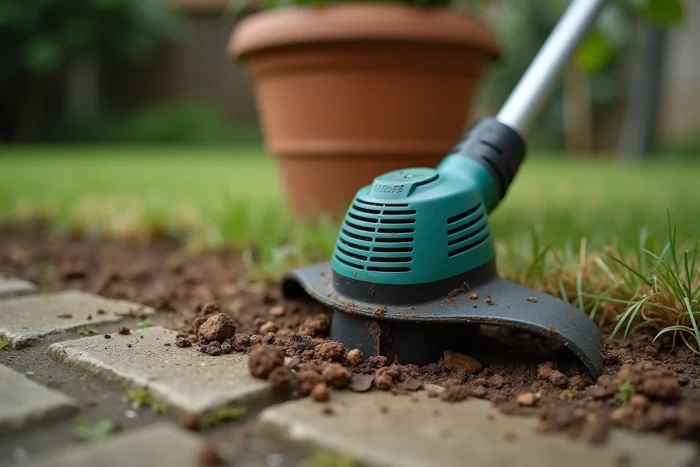
Line, blade, or plastic knives: adapting the cutting head to the terrain
The cutting system determines what can actually be cut, and especially what cannot. Starting from the terrain before choosing the head avoids unpleasant surprises.
- Nylon line (round or square, of various diameters) is suitable for short grass and finishing along paths or flower beds. A line that is too thin on dense grass breaks every two minutes. A square line grips thick vegetation better than a round line.
- Plastic knives replace the line on some entry-level models. They provide a clean cut on well-maintained grass but do not withstand woody stems or brambles.
- The metal blade (often optional on versatile models, sometimes supplied with 2-in-1 brushcutters) tackles underbrush, young shrub regrowth, and tall grass. The blade transforms the trimmer into a lightweight brushcutter, provided the engine can handle it.
In a mixed garden (well-kept lawn plus semi-wild areas), time is saved with a model that accepts both systems. Feedback varies on this point: some users find changing the head tedious, while others consider it quick once the motion is mastered.
Noise and neighborhood: a concrete selection criterion
A petrol trimmer generates a noise level significantly higher than an electric model. Several gardening retailers (Gamm vert, Jardiland, Truffaut) now display noise emission levels in-store, highlighting models that remain below 110 dB(A).
In residential areas, municipal regulations often govern the hours of use for petrol-powered machines. Checking the municipal regulations before purchasing prevents ending up with a machine that can only be used a few hours per week. A quieter model offers a wider range of use, which sometimes compensates for a higher purchase price.
Wearing noise-canceling headphones or molded earplugs is not a luxury: above 100 dB(A), auditory fatigue sets in within a few minutes. This point is often underestimated when comparing two references on a product sheet.
Ergonomics and maintenance of a petrol trimmer
The telescopic handle, anti-vibration handle, shoulder harness: these elements separate a comfortable working session from a chore. An adjustable height handle is almost essential if multiple people use the machine. The harness distributes the weight across the torso and frees the arms to guide the cutting head with precision, especially on slopes.
Routine maintenance of the petrol engine
The air filter should be checked before each season and replaced as soon as it is clogged. The spark plug is changed once a year for domestic use. On a 2-stroke engine, the exhaust gets clogged faster if the mixture is poorly dosed or if low-quality fuel is used.
Winterizing also matters: empty the tank, run the engine until it stops spontaneously, then store the machine in a dry place. A hasty winterization is the leading cause of problems during spring restart.

The choice of a petrol trimmer ultimately comes down to three concrete trade-offs: the type of engine based on tolerance to the mixture and weight, the cutting head based on the actual vegetation in the garden, and the noise level based on local constraints. A model that looks perfect on paper can become unusable if the municipal regulation limits its use to two slots per week, or if fuel preparation becomes a recurring source of breakdowns.