A misaligned copper rod, and an entire detection goes astray. This detail, often overlooked, illustrates the demands placed on dowsing rods: they absorb, filter, and transcribe what the eye ignores. Yet, the slightest electromagnetic interference, the nature of the material, or a simple lapse in maintenance can muddle the reading. The field is full of opposing practices: one praises immersion in saltwater, while the other advocates resting on a bed of quartz. Debates persist, but one certainty prevails: the purity of the tool is not limited to its material or age. It arises from regular maintenance, attention to the context of use, and methodical preparation. It is this rigor that gives the rods their accuracy, terrain after terrain.
What are dowsing rods really used for today?
Far from being relegated to mere curiosities, dowsing rods today assert themselves as versatile instruments. Their reputation was built on the search for underground water, but their scope has significantly expanded. In the field, geobiologists, radiesthesists, and knowledgeable amateurs use them to probe what escapes conventional devices. Detecting telluric networks, water veins, disturbances in the Hartmann or Curry grid—all of this falls under a practice that combines intuition and experience.
In France, uses are diversifying. Here are some concrete applications that are becoming increasingly common:
- Locating a water point to initiate a specific drilling,
- Identifying disturbed areas and restoring the balance of a dwelling,
- Acting on well-being through the practice of feng shui.
Some use them daily, testing the sensitivity of the rods to the contact of objects or spaces, to gauge the vibrational atmosphere. What catches attention is their ability to transmit subtle information without the intermediary of an electronic device. But to ensure this reliability, maintenance must never be neglected. Among the proven methods, purifying dowsing rods with Bargemon stands out as a valuable resource. Each detection requires its preparation, respecting both traditions and the most recent methods of geobiology.
Purification and maintenance: simple gestures to preserve the effectiveness of your rods
Caring for your rods: a condition for reliability
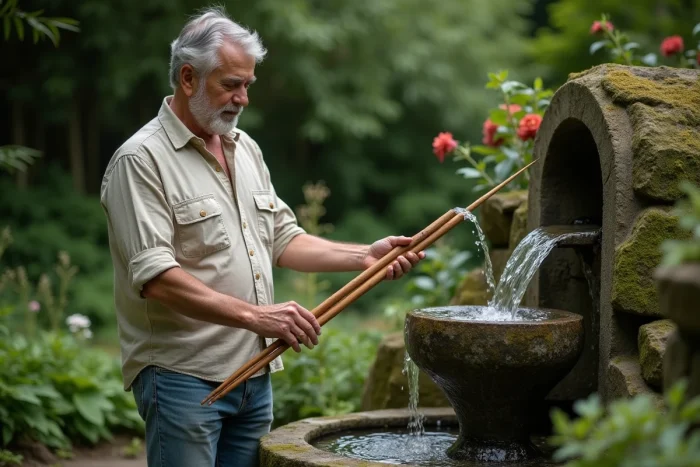
For those seeking precision, purification and frequent cleaning are not trivial matters. The rods, whether made of brass, copper, or wood, react to the energetic environment, sometimes absorbing undesirable influences over time. A rinse under clear water, a careful drying with a natural cloth: this simple gesture eliminates most residual charges. Some choose fumigation with sage or cade wood, thus enhancing the energetic protection of their tools.
Some precautions are necessary to keep the neutrality of the rods intact:
- Keep the rods away from electromagnetic fields and electronic devices,
- Store them in a quiet place, away from traffic,
- Ensure that each rod is handled with clean hands, free from residues of cosmetic substances.
Regular cleaning limits interferences and also protects the practitioner from potential imbalances. The Bargemon method combines traditional gestures with advice from modern geobiology. Adopting a routine, repeating the same gestures at each session, also gives the tool the consistency and reliability expected. When maintenance becomes a ritual, the rod becomes a faithful link between the seeker and the invisible networks they wish to reveal.

Discovering geobiology and radiesthesia: why train to go further?
Geobiology and radiesthesia form a universe where spontaneity is not enough. Grasping the significance of the rods, understanding the influence of telluric networks, or locating a source—all of this can be learned. A structured training provides benchmarks, avoids haphazard interpretations, and refines the reading of the Hartmann and Curry networks.
Enriching one’s knowledge also means taking a fresh look at the environment. Detecting the energies that flow through a house, understanding the impact of the ground on well-being, or getting acquainted with precise tools: practice is refined with technical documents, fact sheets, and case analyses. Specialized courses cover both water searching and understanding underground networks.
Examples of modules offered
To illustrate the diversity of teachings, here are some modules frequently included in training programs:
- Detailed reading of telluric networks and their impact on habitat,
- Application of a methodical guide to locate a source or harmonize a space,
- Practical sessions: field surveys, analysis of photographs, compilation of study files.
Decoding geobiology is neither improvisation nor relying on luck. It is a path of learning, precise gestures, and attentive observations, where each tool, each measurement, each document enriches valuable expertise. And this demand, far from being a constraint, becomes the promise of a sharper perspective on the invisible that structures our living spaces.