
On a Renault Clio 2, the anti-theft system relies on several components distributed throughout the cabin and the engine compartment. Identifying the correct element among the UCH, the transponder ring, and the engine control unit avoids hours of blind diagnostics. The main difficulty lies in the fact that the precise location varies depending on the vehicle’s phase and its engine type.
Anti-theft light Clio 2: read the symptom before looking for the unit
Before disassembling anything, the behavior of the red light on the dashboard already points towards the failure area. This symptomatic sorting saves considerable time.
A blinking light while the engine is cranking but not starting indicates a key that is not read or rejected by the system. The fault is then located either at the transponder ring or at the chip integrated into the key.
A steady light followed by a start and then an almost immediate stop points more towards a communication problem between the UCH and the engine control unit. The start authorization is transmitted but not validated at the end of the chain.
An entirely absent light as soon as the ignition is turned on should lead to checking the power supply and fuses of the module. The fuse F32, which protects the UCH, deserves priority verification. Locating the location of the anti-theft unit Clio 2 becomes relevant once this initial sorting is done.
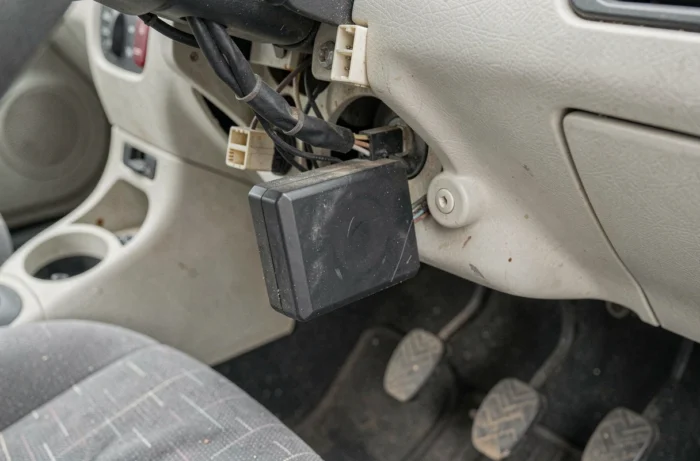
UCH, ring, and engine control unit: three components not to be confused
The anti-theft system of the Clio 2 is not limited to a single unit. It consists of three distinct elements, each having its own role and location.
| Component | Location | Role in the anti-theft system | Associated fault indicator |
|---|---|---|---|
| UCH (Central Cabin Unit) | Under the dashboard, driver’s side, behind the trim | Receives the transponder code and authorizes the start | Multiple simultaneous failures (central locking, lighting, wipers, turn signals) |
| Transponder ring | Around the ignition switch (cylinder) | Captures the signal emitted by the key’s chip | Blinking light, unrecognized key |
| Engine control unit | Engine compartment, mounted near the passenger side firewall (varies by engine type) | Checks the authorization received from the UCH before activating injection and ignition | Start then immediate engine stop |
The UCH is the component most often implicated in recurring anti-theft failures. A faulty UCH rarely causes a single isolated symptom. Anomalies in central locking, electric windows, or interior lighting appear simultaneously. This combination of malfunctions constitutes a reliable indicator for guiding the diagnosis.
Physically accessing the UCH
The UCH is located behind the lower trim of the dashboard, on the left side. To access it, the cover under the steering wheel must be removed, held by Torx screws or clips depending on the production phase. The electronic unit then appears, connected by a harness of several pins.
The transponder ring, on the other hand, is invisible without disassembly. It surrounds the ignition cylinder and is presented in the form of a ring connected by a thin wire to the UCH connector.
Engine control unit Clio 2: references that change depending on the version
Specialized sources show that the engine control unit varies depending on the engine type and production phase. On the 1.4 and 1.6 16V petrol versions, Siemens Sirius 32 control units are encountered. Some Clio 2 models equipped with the 1.2 16V engine use Magneti Marelli IAW 5NR2 control units.
This distinction has a direct consequence: in case of replacement of the control unit, the Renault reference written on the label of the unit must match exactly. A control unit of the same brand but with a different reference will not be recognized by the UCH, and the anti-theft system will block the start.
- Before any intervention, note the complete reference on the label attached to the engine control unit
- Compare this reference with that of the replacement control unit (same Renault number, same software version)
- Plan for reprogramming the UCH-control unit pair if the two elements are not of common origin
Replacing a control unit alone, without synchronization with the UCH, will systematically result in an anti-theft blockage. This operation requires a diagnostic tool capable of reading and writing the pairing codes between the two modules.
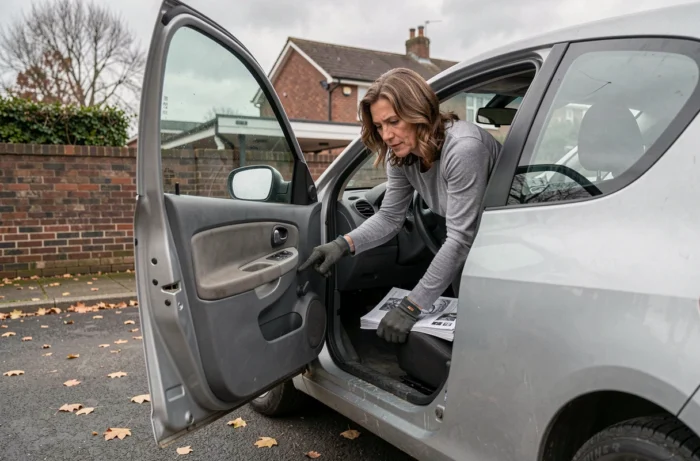
Anti-theft diagnosis Clio 2: the elimination method
Rather than systematic disassembly, a sequential approach reduces the risk of error and the cost of intervention.
Step 1: check the fuses
The cabin fuse box is located under the dashboard, on the driver’s side. The fuse F32 directly protects the UCH and the anti-theft circuit. The fuse F36 powers the transponder circuit. A blown fuse in one of these locations explains a total refusal to start without any other apparent electrical symptoms.
Step 2: test with the second key
The Clio 2 comes with two keys, each containing a transponder. If the vehicle starts with the second key, the fault comes from the chip of the first key and not from the UCH unit or the ring.
Step 3: observe associated failures
If the central locking, turn signals, or wipers show simultaneous malfunctions, the UCH is likely at fault. However, if only the starting is affected and the light blinks normally, the transponder ring or the engine control unit become the primary suspects.
The anti-theft code is written on a card or in the maintenance booklet provided with the vehicle. This code allows a professional to reprogram a key or reset the UCH-control unit pairing. Without this code, the intervention becomes significantly more complex and costly.
On a used vehicle with the booklet missing, some specialized repairers can extract the code directly from the UCH using a dedicated diagnostic tool, provided that the module is still functional. Checking for the presence of this card when purchasing a Clio 2 remains the simplest reflex to avoid a subsequent blockage.