A welcoming and functional home is based on a simple principle: every square meter serves a specific purpose, tailored to the actual habits of its occupants. Decoration comes after this step, not before. Arranging a home is first about balancing circulation, storage, and comfort, and only then choosing colors or materials.
Reversibility of spaces: the principle of retractable furniture for remote work
Domestic arrangements have changed since the widespread adoption of remote work. The 2024 barometer from the ANACT Telework Observatory highlights a growing attention to the possibility of visually disappearing the workspace at the end of the day. Retractable desks, partitions, cabinet furniture: the workspace must be able to revert to living space in a matter of seconds.
This logic of reversibility goes beyond just a desk corner. A dining table that serves as a work surface in the morning, a removable partition that isolates a space during the day and frees up volume in the evening: transformable furniture meets a concrete need, not a decorative trend. The criterion for choice is the speed of transition between the two configurations.
Compact acoustic booths, initially designed for professional open spaces, are appearing in homes. They provide decent sound insulation without construction work and can be moved from room to room. To explore different approaches to interior arrangement, you can visit the Exploractu website, which regularly covers these topics.

Accessibility and universal design applied to everyday arrangements
Accessibility is not just about housing adapted for disabilities. The guide “Evolving Habitat” published by the National Old Age Insurance Fund (CNAV) in 2023 notes a significant increase in renovation projects anticipating aging at home, including among households under 50 years old.
Universal design translates into concrete choices that benefit all occupants, regardless of their age or mobility. Here are some criteria to check room by room:
- Width of passages: ensure at least enough space to move with a bulky item (stroller, shopping cart, wheelchair), which also improves daily comfort
- Height of storage: the most frequently used shelves and cabinets should remain accessible without a step stool, ideally between hip and shoulder height
- Absence of thresholds between rooms: a continuous floor reduces the risk of falls and simplifies the passage of a robot vacuum
- Visual contrasts on switches and handles: a clear color difference between the wall and the control makes it easier to locate, even in low light
Integrating these principles from the design stage avoids costly work later. A kitchen countertop at the right height, sufficiently wide doors, electrical outlets placed at mid-height: these details cost almost nothing during construction but are very expensive to correct afterward.
Integrated storage: thinking in terms of usage zones rather than rooms
Most storage advice thinks in terms of rooms: the kitchen, the bedroom, the living room. This approach produces duplicates and dead zones. Thinking in terms of usage zones yields more sustainable results.
A usage zone groups objects related to the same activity, regardless of where they are in the house. Care materials (first aid kit, common medications, thermometer) are better placed near the most frequently used water point than in a bedroom cabinet at the end of the hallway. Chargers and cables deserve a closed cabinet in the living area, not a box under the bed.
Applying the method to the entrance
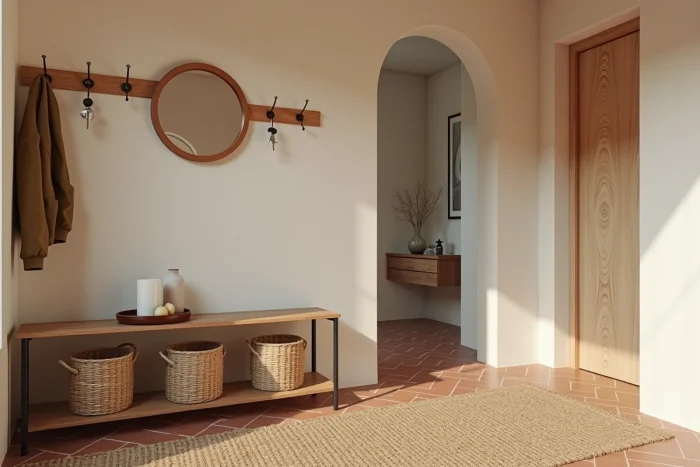
The entrance concentrates several usage zones in a few square meters: outgoing (keys, bag, shoes of the day), returning (mail, clothes to hang), seasonal storage (coats, umbrellas). A single piece of furniture trying to absorb everything ends up cluttered. Physically separating these three functions, even with simple elements (hooks at different heights, a closed bin for shoes, a wall pocket for keys), makes the space more readable.
Home lighting: layering three levels of light
Functional lighting relies on layering three distinct sources in each living space. A single central ceiling light is never enough to create a space that is both practical and pleasant.
The first level is general lighting (ceiling light or pendant) that ensures overall visibility. The second is task lighting (desk lamp, under-cabinet lights in the kitchen, reading lamp) that focuses light where a specific activity requires it. The third is ambient lighting (string lights, table lamps, LED candles) that softens the atmosphere in the evening.
Layering these three levels allows you to adapt the light to the time of day without turning everything on or off. A dimmer on the general lighting costs little and radically changes the perceived comfort of a room. The mirror, often cited as a decor tip, plays a concrete role in spreading natural light: placed opposite a window, it redistributes brightness to the darkest areas.
Colors and materials serving visual circulation
The choice of colors in an interior is not just a matter of taste. Light shades on the walls visually enlarge a narrow space, while a darker wall at the end of a hallway creates a sense of depth. This principle, used in scenography, directly applies to domestic arrangements.
Materials contribute to the same effect. A matte surface absorbs light and soothes the ambiance. A shiny surface (tiles, lacquer, glass) reflects it and energizes the room. Alternating the two in the same room creates a contrast that guides the eye without overloading the decor.
The floor deserves special attention: a continuous covering between two open spaces (living room and kitchen, for example) visually unifies the volume. Changing the flooring material marks an implicit boundary between two functions without needing a partition.
A successful arrangement is recognized by one detail: occupants do not search for anything. Everyday objects are where the hand expects them, the light adapts to the time, and every nook has found its function. The rest is decoration, and decoration can be easily changed.